
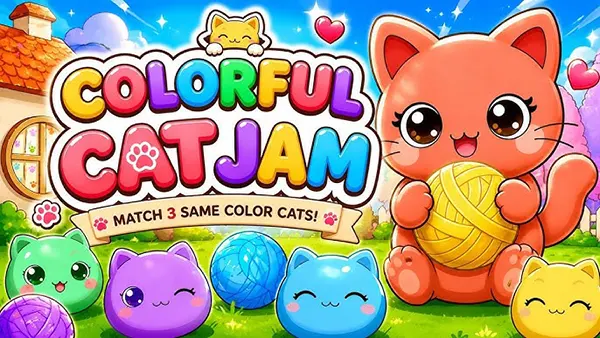
Colorful Cat Jam: How Simple Puzzle Mechanics Hold Attention in Short Mobile Sessions
Colorful Cat Jam is a casual matching puzzle from MOBIRIX built around an unusually small set of actions: tap cats, move them into a collection bar, combine three of the same colour and clear the level by rescuing the kittens hidden in tents. That basic description explains much of its suitability for short Android sessions. The game does not ask players to memorise elaborate controls, manage several resources at once or race against a visible countdown. Instead, it creates small decisions that can be understood almost immediately but still require enough planning to prevent the collection bar from becoming awkwardly filled. As of 2026, its Google Play listing describes more than 100 levels, eight cat colours, several recovery boosters, daily missions and a separate cat-home element. Together, these features give a simple puzzle loop enough variety to work during a spare five minutes without turning each session into a lengthy commitment.
Why the Core Puzzle Loop Works in Short Sessions
The first strength of Colorful Cat Jam is how little preparation a player needs before making a useful move. A tap sends a cat to the collection bar, while three cats of the same colour disappear once grouped together. There is no need to drag pieces across a large board, learn complicated combinations or remember a long chain of special commands. A player can look at the visible cats, identify a useful colour and act within seconds. That matters on a phone, where a session may start while travelling, during a break or while waiting for something else. The game can return to its main decision quickly instead of spending the opening minutes on menus or lengthy setup. Simple controls do not mean that every choice is automatic, however. Selecting a cat also changes the contents of the collection bar, so an easy tap can create a problem several moves later.
The three-of-a-kind rule gives each level an immediately understandable rhythm. One matching cat is a start, a second creates a near-complete set and a third removes all three from the bar. This makes progress easy to read without requiring constant explanations on the screen. The player can see several small objectives forming at once and decide which set is safest to complete first. If too many different colours enter the bar without forming triples, the available room becomes increasingly valuable. That is where the puzzle gains tension without needing a timer. The pressure comes from the consequences of previous choices rather than from a clock. For short sessions, this is useful because the game can remain calm in presentation while still giving the player a reason to pay attention to every tap.
The rescue objective adds another layer of clarity. Clearing cats and tents is not simply a way to increase a score; it moves the player towards freeing the kittens and completing the stage. This gives a short level an identifiable beginning, middle and end. A player entering for a few minutes can make progress towards a specific goal and receive a clear completion point rather than leaving after an arbitrary amount of play. The absence of a chasing timer also changes the pace. A short session does not have to feel rushed simply because it is short. Players can spend a few seconds examining the available colours, consider which cats should enter the bar and continue when ready. That combination of compact levels and unhurried decisions is central to the game’s casual character.
The Collection Bar Adds More Planning Than the Controls Suggest
The collection bar is where Colorful Cat Jam turns a one-tap control scheme into an actual puzzle. Tapping the most obvious cat is not always the best move, because every unmatched colour temporarily occupies useful space. A player therefore has to think about what can be completed soon rather than simply choosing any available piece. If two cats of one colour are already waiting in the bar, finding the third can immediately free room. Starting several new colour groups at the same time can have the opposite effect. The game does not require complex calculation to make this interesting. A few visible options are enough to create a practical question: should the player finish an existing trio, prepare a future match or uncover something that may make the board easier on the next move?
The eight cat colours listed for the Android version help support this decision-making while keeping the objects familiar. Colour works as an instant visual category, so players do not have to read labels or remember what each piece does. The cats also have distinct expressions and hand-drawn appearances, preventing the board from looking like a purely abstract set of tiles. This balance is important for a casual puzzle. The pieces have enough personality to make the screen visually pleasant, yet their main function remains easy to identify. During a brief session, that readability reduces the time needed to work out what is happening after returning to the game. Instead of relearning a large interface, the player can quickly recognise the active groups and continue making matches.
Tents further shape the sequence of moves because the board is about more than removing whichever cats are immediately convenient. Rescuing the trapped kittens provides a practical reason to keep clearing the arrangement and reaching deeper parts of a level. As more cats are removed, new useful combinations may become available, while poorly timed selections can leave awkward colours sitting in the bar. This creates a repeating cycle of observation, choice and reward that takes only a few seconds at a time. A longer strategy game may need several minutes before a decision produces a visible result; Colorful Cat Jam usually makes the effect of a tap apparent almost immediately. That quick response is well suited to mobile play because even a very short session can contain numerous complete decision-and-result cycles.
How Difficulty Grows Without Making the Game Feel Heavy
Simple puzzle games need progression because rules that remain unchanged can become predictable quickly. Colorful Cat Jam addresses this mainly through its level structure rather than by constantly adding new control systems. Google Play describes more than 100 levels with gradually increasing difficulty. The important point is not simply the number of stages but what a level-based format allows: familiar rules can be arranged into increasingly demanding situations. Early play can establish the basic relationship between cats, triples and the collection bar, while later layouts can ask the player to pay closer attention to sequence and available space. The controls remain the same, so increased difficulty does not require a fresh tutorial every few minutes. Players improve mainly by becoming more careful about which colour they select and when they commit valuable bar space.
This approach fits short sessions because progress can be divided into individual levels rather than one long uninterrupted challenge. A player may complete a stage and stop with a natural sense that something has been finished. Returning later does not require remembering a complicated chain of earlier actions or rebuilding a detailed plan from scratch. At the same time, the growing difficulty gives later sessions a reason to feel different from the first few rounds. The game can ask for more patience without abandoning the original rules that made it easy to pick up. This distinction matters in casual mobile design: adding difficulty is not the same as adding complexity. A game can make familiar choices more consequential while keeping the actual method of interaction straightforward.
The lack of a visible race against time also gives harder layouts room to challenge players without changing the overall mood. If a player has only a few minutes available, losing because a timer expired could make the session feel cut short for an external reason. Here, the more relevant threat is usually the state created by the player’s own selections. That keeps attention focused on the board. A difficult position asks for a better sequence rather than faster fingers. This also means pauses between moves are not inherently harmful. Someone can check the board carefully before tapping again, which is particularly practical on a phone where interruptions are common. The game still creates mistakes and difficult situations, but it does so through puzzle choices rather than speed alone.
Boosters Turn Mistakes Into Recoverable Situations
Colorful Cat Jam includes four named boosters on its Android store page: Undo, Shuffle, Magnet and Add Space. Their presence is significant because each one addresses a common type of frustration in a matching puzzle. Undo provides a way to reconsider a poor selection. Shuffle can alter a position when useful matches are difficult to reach. Magnet assists with bringing relevant pieces together, while Add Space directly addresses pressure in the collection area. These tools do not replace the core rule of creating triples; they provide ways to recover when the current arrangement has become uncomfortable. As a result, the player can spend most of the session using the same basic matching skill and call on a booster only when a problem becomes difficult to solve normally.
Recovery tools are particularly useful in short mobile play because restarting a level can consume a disproportionate share of a brief session. Imagine making one poor tap near the end of a stage after several minutes of careful matching. An immediate failure and complete restart would make that single error unusually costly for someone who only intended to play for five minutes. A suitable booster can instead preserve some of the progress already made. This does not remove the need for careful choices, since boosters are separate resources rather than ordinary moves, but it gives the game another way to handle difficulty. The important design choice is that assistance is tied to problems players can understand: the previous move was wrong, the layout is awkward or the bar needs more room.
The boosters also make the puzzle easier to resume after a gap. A returning player does not need detailed knowledge of a complicated power system to understand what an Undo or Shuffle action is likely to do. The names correspond closely to their purpose, which keeps the learning burden low. That matters when sessions are separated by hours or days. Mobile games often have to serve players who remember the basic goal but not every secondary feature. Colorful Cat Jam keeps its support tools close to familiar puzzle concepts, allowing the focus to return quickly to matching cats. This keeps the feature set broader than a bare triple-match game without allowing those extra features to overshadow the main interaction.

How Feedback and Light Progression Encourage Another Session
A puzzle can be mechanically clear and still feel flat if every successful action produces little response. Colorful Cat Jam uses a softer presentation to make frequent small actions feel noticeable. Its official Android description highlights hand-drawn artwork, warm pastel colours, matching-and-pop feedback, gentle haptics and a relaxed soundtrack. None of these elements changes the matching rule, but together they make the repeated act of completing a trio more distinct. This matters because most of the game is built from very small actions. If a player may make dozens of taps in a brief session, each response needs to remain readable without becoming tiring. Visual changes, sound and light vibration provide confirmation that a choice has produced a result, reducing the need for additional text or complicated effects.
The cats themselves also make progress easier to remember than anonymous puzzle pieces might. The objective is framed as rescuing kittens rather than simply deleting matching objects from a board. After a level, rescued cats contribute to a separate cosy home where they can be petted and their moods observed. This gives the puzzle activity a light sense of continuity between stages. The home feature does not require the player to manage an elaborate simulation; it works more as a persistent reminder of previous progress. That suits the overall structure because the main puzzle can stay compact while still contributing to something that exists beyond a single round. A five-minute session therefore has two scales of progress: finishing the immediate level and gradually building the collection of rescued cats.
Mystery boxes add another small reward layer. Again, the significance is not that they transform the central gameplay, but that they punctuate repeated puzzle sessions with outcomes that are not identical every time. A level already offers the satisfaction of clearing the board, while a surprise reward can provide an additional reason to notice the end of a stage. In a game based on a deliberately limited set of controls, these secondary rewards help vary the rhythm without forcing the player to learn a new game mode for every change of pace. The result is a design that adds material around the matching loop rather than constantly replacing it. That is one reason the game can remain approachable while still giving returning players several forms of progress to follow.
Daily Goals Give Short Play a Reason to Continue Across Days
Colorful Cat Jam supplements its individual levels with daily rewards, daily missions and special bonuses. These systems shift part of the motivation from completing one stage to maintaining a light routine. A player does not necessarily need a long session to take part. A short visit can be enough to collect a reward, check a mission or complete another puzzle. That is different from demanding several hours of continuous play. The daily structure gives a reason to return while the underlying activity still works in small portions. This is especially compatible with the matching design because a player can move directly from a daily objective into a familiar level without needing to relearn controls or spend several minutes preparing a character, inventory or tactical setup.
There is an important distinction between giving players a reason to return and making each individual session longer. Colorful Cat Jam appears more focused on the former. The puzzle loop is already compact, so daily goals can connect several small sessions over time rather than turning one sitting into an extensive commitment. The cosy cat home serves a similar role. Every rescued kitten contributes to a collection that remains relevant after the current board has been cleared. This gives the player a continuing objective but does not make every level dependent on lengthy management between puzzles. Someone interested mainly in matching can keep playing levels, while the home and daily systems provide additional context for returning later.
As of August 2026, Colorful Cat Jam is still a relatively new release. The Google Play page lists MOBIRIX’s Android version as having launched worldwide and shows an update dated 27 July 2026, while the developer indicates that further updates are planned. The store listing also discloses advertising and in-app purchases, so those elements are part of the current Android release even though the listing does not specify how frequently individual players will encounter them. What can already be judged more clearly is the structure of the game itself. Its attention loop depends on familiar colours, one-tap choices, limited collection space, quick triple matches, recoverable mistakes, rescue goals and light progress between sessions. Instead of relying on complicated rules, Colorful Cat Jam gives a small number of actions enough consequences to remain engaging for the few minutes that casual mobile play often has available.